Overview
This project implements a complete discrete-time Kalman filter for state estimation and a residual-based fault detection system using statistical hypothesis testing. The system is modeled as a double integrator (position and velocity), subject to Gaussian process and measurement noise. The Kalman filter reconstructs unmeasured states from noisy measurements, while the innovation (residual) sequence is analyzed to detect sensor faults.
The notebook demonstrates core principles of robust and fault-tolerant control, including state-space modeling, covariance propagation, innovation-based diagnostics, and chi-squared statistical testing. Detection performance is quantified using Normalized Innovation Squared (NIS) and Receiver Operating Characteristic (ROC) analysis. The project highlights how model-based estimation and statistical decision theory form the foundation of modern fault detection and robust control systems.
The Jupyter Notebook combines mathematical derivations with executable simulations and visual analysis.
System Modeling
Discrete-time state-space representation
Double integrator dynamics
Process noise covariance (Q)
Measurement noise variance (R)
Kalman Filter Outputs
True vs noisy measurements
True vs estimated position and velocity
Residual (innovation) sequence
Innovation covariance tracking
RMSE metrics for estimation accuracy
Fault Detection Analysis
Residual comparison (healthy vs faulty case)
Normalized Innovation Squared (NIS) values
Chi-squared detection threshold
Detection rate statistics
Performance Evaluation
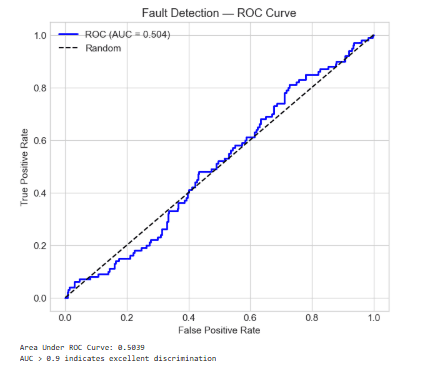
ROC curve
Area Under Curve (AUC) metric
All equations are rendered in LaTeX alongside implementation code, and the notebook renders natively on GitHub.
Key Engineering Concepts
State-Space Modeling
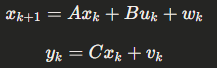
Linear discrete-time system
Gaussian process noise wk∼N(0,Q)
Gaussian measurement noise vk∼N(0,R)
Kalman Filter (Predict–Update)
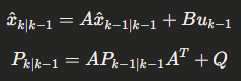
Predict:
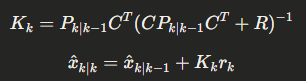
Update:
Covariance propagation
Innovation sequence rk=yk−Cx^k∣k−1
Fault Detection (NIS)
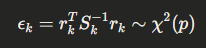
Chi-squared hypothesis testing
Statistical thresholding (99% confidence)
Model-based fault detection
ROC Analysis
False Positive Rate (FPR)
True Positive Rate (TPR)
Area Under Curve (AUC)
Quantifies discrimination between healthy and faulty conditions.
Example Scenarios / Validation
1. Healthy System Estimation
The Kalman filter closely tracks true position and velocity despite noisy measurements. RMSE remains low, validating estimator accuracy.
2. Sensor Bias Fault Injection
A 3 m measurement bias introduced at k = 100 causes residuals to spike and NIS values to exceed the chi-squared threshold.
3. Detection Rate Analysis
Post-fault samples show high exceedance of threshold, yielding detection rates typically above 90% in nominal scenarios.
4. ROC-Based Evaluation
ROC curve visualizes detection performance. AUC quantifies separability between healthy and faulty cases.
5. Noise Sensitivity
Higher measurement noise increases residual variance and may reduce detection reliability — illustrating robustness trade-offs.
Tech Stack
Python, Jupyter Notebook, NumPy, SciPy, Matplotlib, Scikit-learn (ROC/AUC), GitHub native notebook rendering.