Overview
This project implements a complete digital twin of a CNC milling process using a Jupyter Notebook-based simulation environment. The model integrates cutting force prediction (Kienzle equation), tool wear evolution (Taylor’s tool life law), energy consumption modeling (idle + cutting power), surface roughness estimation, and sustainability KPIs such as CO₂ per part and material utilization.
The digital twin replicates real machining behavior and compares simulated predictions with “measured” data to enable anomaly detection and predictive maintenance. The project demonstrates key concepts in digital modelling, process simulation, sustainable manufacturing, and Industry 4.0 digital twin synchronization, aligning directly with modern digital production technologies.
What the Notebook Shows
The notebook acts as a structured digital twin simulation environment and includes:
Cutting force outputs for 4 industrial materials (steel, aluminum, stainless, titanium)
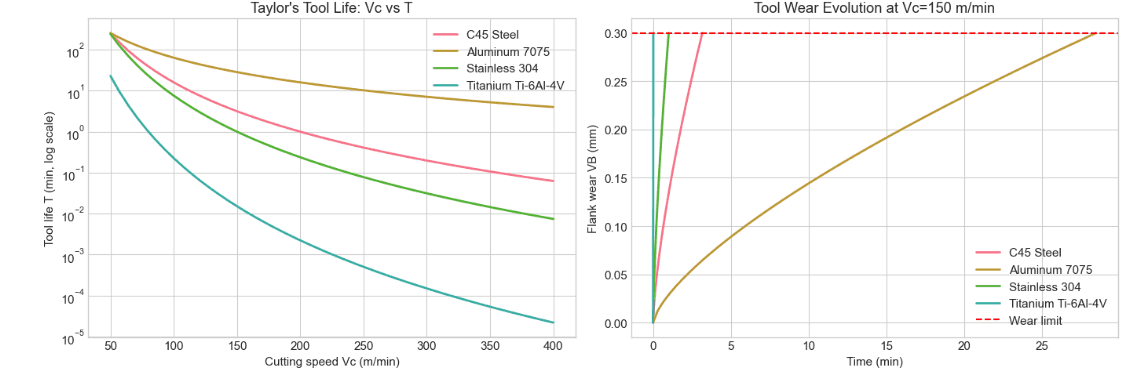
Tool life vs cutting speed plots (log-scale Taylor curves)
Tool wear evolution curves up to wear limit
Power breakdown: idle vs cutting power (kW)
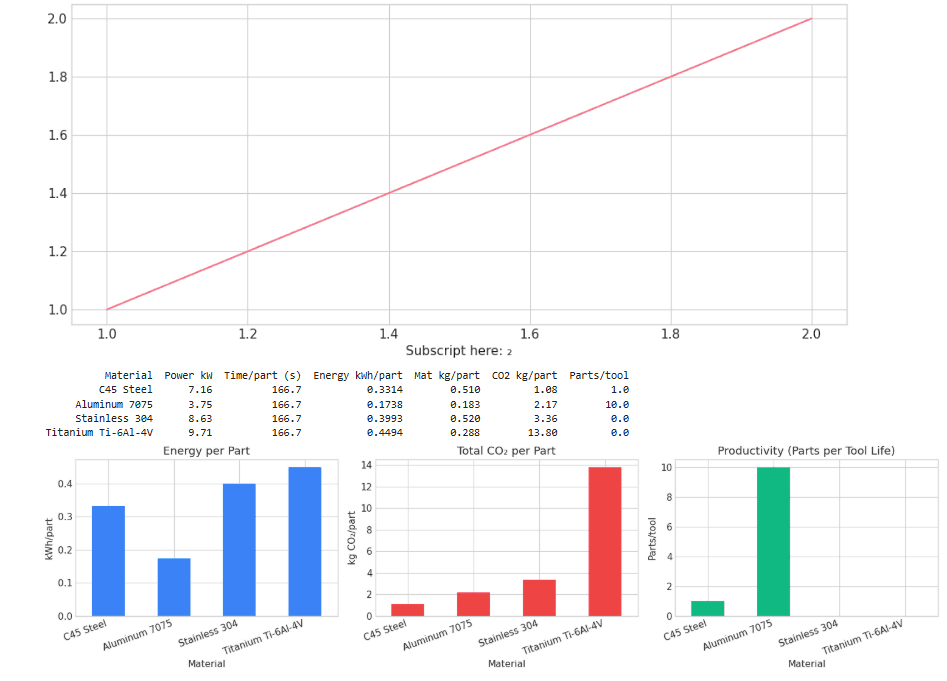
Energy per part (kWh) and machining time estimates
Surface roughness prediction (Ra) from feed and tool geometry
Sustainability KPIs: CO₂ per part, material consumption (kg/part), productivity (parts/tool)
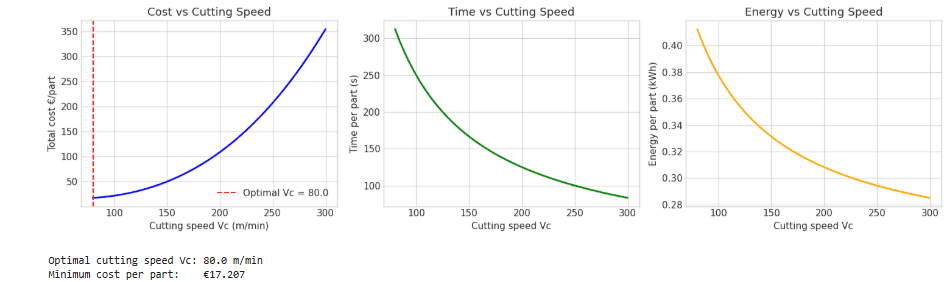
Cost optimization plots: cost vs cutting speed with optimal Vc highlighted
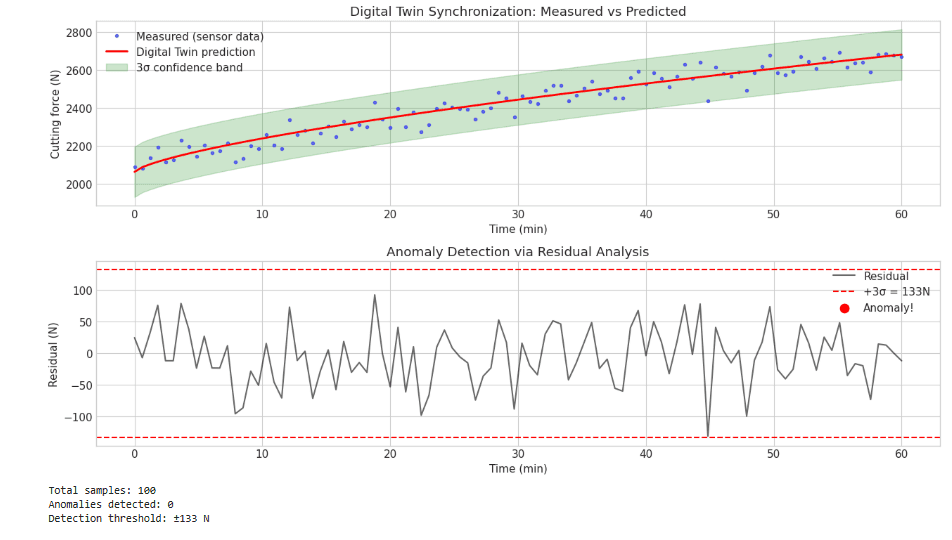
Digital twin synchronization: measured vs predicted cutting force with 3σ anomaly detection
All plots render directly in GitHub via native .ipynb visualization.
Key Engineering Concepts
Kienzle Cutting Force Model
Fc=kc,1.1⋅b⋅h1−mcFc=kc,1.1⋅b⋅h1−mcTaylor’s Tool Life Equation
Vc⋅Tn=CVc⋅Tn=CEnergy Model
Ptotal=Pidle+Fc⋅Vc60⋅1000Ptotal=Pidle+60⋅1000Fc⋅VcSurface Roughness Approximation
Ra≈f28rRa≈8rf2Machining Time Estimation via Material Removal Rate (MRR)
Sustainability Analytics
Energy-based CO₂ emissions (grid factor)
Embedded material carbon
Productivity (parts per tool life)
Process Optimization
Single-variable cost minimization using SciPy (minimize_scalar)Digital Twin Synchronization
Residual analysis with ±3σ threshold for anomaly detection
Example Scenarios / Validation
1. Material Comparison
Titanium shows the highest cutting force and CO₂ per part, while aluminum demonstrates the lowest energy consumption.
2. Cutting Speed Trade-off
Increasing cutting speed reduces machining time but dramatically decreases tool life (log-scale Taylor behavior).
3. Cost Optimization
A U-shaped cost curve reveals an optimal cutting speed (~150–200 m/min for steel) balancing energy, tool wear, and overhead.
4. Sustainability Impact
Embedded material carbon dominates total CO₂ for high-impact materials like titanium.
5. Digital Twin Monitoring
Measured cutting force data deviating beyond ±3σ from model prediction is automatically flagged as an anomaly.
Tech Stack
Python, Jupyter Notebook, NumPy, Pandas, Matplotlib, Seaborn, SciPy (optimization & numerical modeling), GitHub native notebook rendering.