Overview
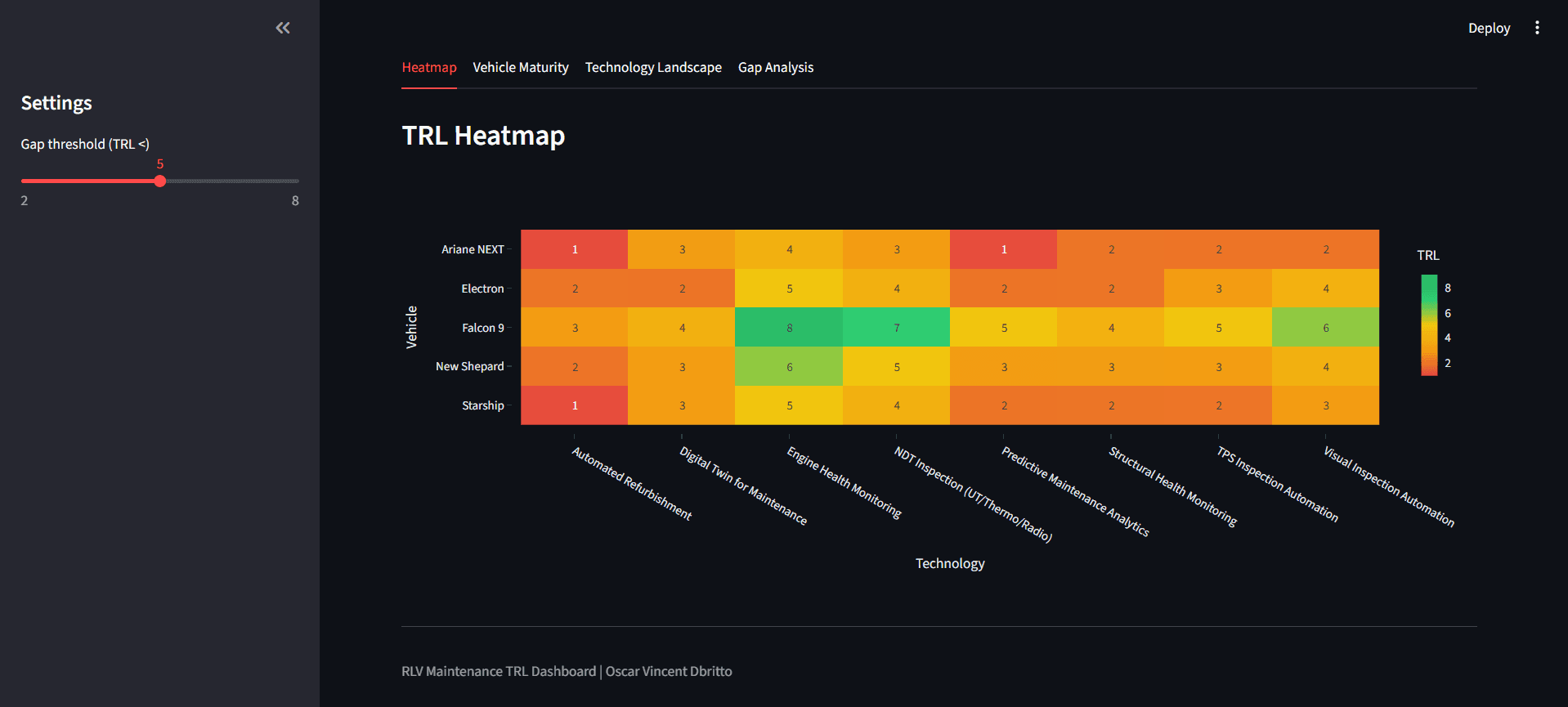
Interactive TRL (Technology Readiness Level) assessment dashboard quantifying the maturity of maintenance technologies across Reusable Launch Vehicles (RLVs). Evaluates 8 maintenance technology categories across 5 vehicles — producing 40 individual TRL assessments with derived gap analysis and prioritised recommendations.
Screenshots
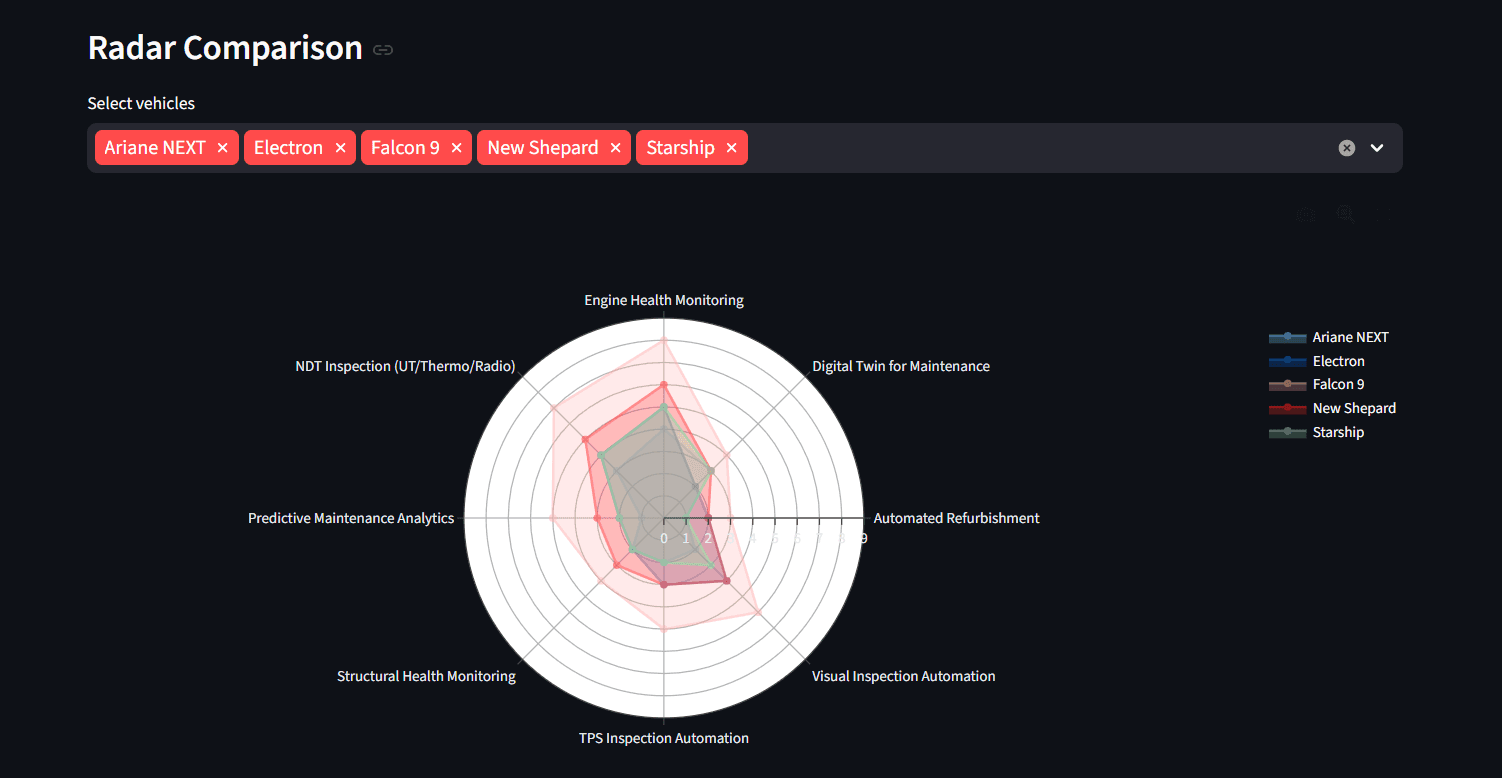
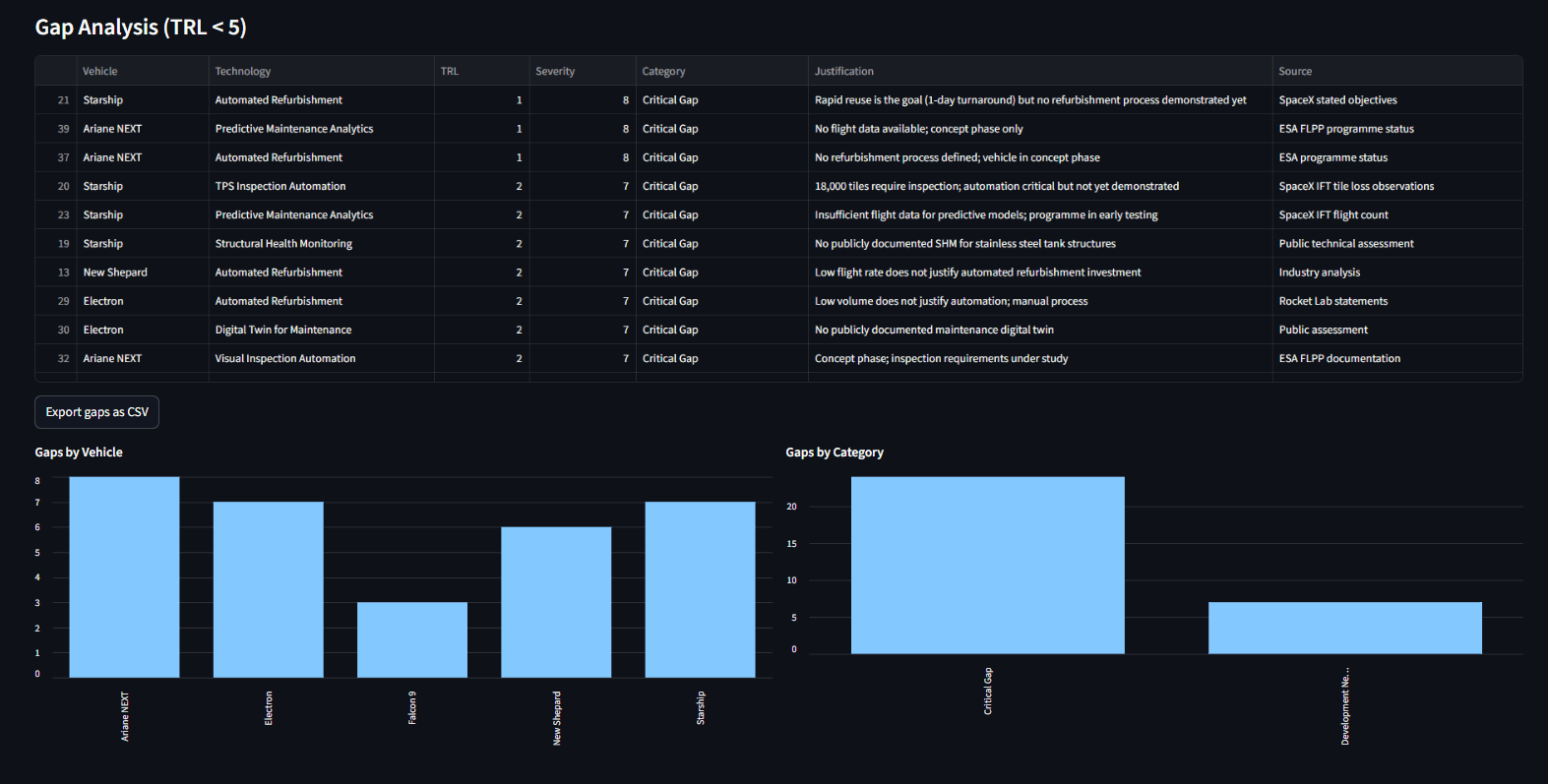
TRL Heatmap | Radar Comparison | Gap Analysis |
|---|---|---|
 |  |  |
Features
TRL Heatmap — colour-coded matrix (red = low TRL = gap, green = high TRL = mature); adjustable gap threshold slider
Vehicle Maturity Scores — ranked bar chart of overall maintenance technology maturity per vehicle
Radar Comparison — multi-vehicle overlay radar chart across all 8 technology dimensions
Technology Landscape — per-technology statistics (min, max, mean, spread) with leading vehicle identification
Gap Analysis — prioritised gap table (Critical / Development Needed / Validation Required) with TRL justifications and sources
CSV Export — download filtered gap table for further analysis
TRL Scale Reference
TRL | Description |
|---|---|
1 | Basic principles observed |
2 | Technology concept formulated |
3 | Experimental proof of concept |
4 | Technology validated in lab |
5 | Technology validated in relevant environment |
6 | Technology demonstrated in relevant environment |
7 | System prototype demonstration in operational environment |
8 | System complete and qualified |
9 | Actual system proven in operational environment |
Context
Built in the context of DLR Institute of Maintenance and Modification research on maintenance considerations for Reusable Launch Vehicles. As stated in the DLR research brief, maintenance technology for RLVs "remains in its infancy" — this dashboard quantifies exactly where the gaps are using the NASA/ESA TRL framework standard at DLR, ESA, and NASA.
Relevance
Directly mirrors DLR research tasks: assess and quantify maintenance technology maturity for RLVs Applies the industry-standard NASA/ESA TRL framework used operationally at DLR Identifies critical gaps (TRL ≤ 3) requiring immediate R&D investment Supports life cycle analysis and maintenance technology roadmap planning Demonstrates structured, data-driven approach to scientific technology assessment